
The lowdown on mistletoe
/
Mistletoe sprigs, ready for hanging. — Sunchild57 Photography/Creative Commons
As far as I can tell, it’s been some while since anyone saw Mommy kissing Santa Claus underneath the mistletoe.
Few people seem to get with the mistletoe program these days. I haven’t seen sprigs of this curious plant offered for sale in recent seasons, although I may just be shopping in all the wrong places. I’m beginning to think there’s a generational divide here, with a tame little excuse for stealing kisses holding no water in our sexually sensitive times.
In my youth, mistletoe was a common holiday item, and I can still picture the berried twigs that came packaged in envelopes of crinkly cellophane. The sprig, bound with a fine red ribbon, was hung above a doorway where family members (who inevitably forgot it was there) would find themselves affectionately ambushed.
Vaguely, I remember being grabbed and smooched, mostly by rowdy uncles who’d had a few too many glasses of eggnog. It was always a gigglesome sort of surprise attack, especially when the victim was my brother, who had a boy’s pathological dislike of any mushy stuff.
In times long past, mind you, mistletoe was taken very seriously indeed.
Kissing under the mistletoe was part of the Roman winter solstice festival of Saturnalia, accounting for its association with the Christian Christmas, which co-opted the date and practices of earlier pagan celebrations. The “Golden Bough” of Greek myth was likely a species of European mistletoe, Viscum album, which takes on a golden cast during winter months.
The Druids revered mistletoe growing on oaks — which it did rarely, preferring apple trees as hosts. Around the winter solstice, Druidic priests would cut down the mistletoe using a special golden sickle, catching it in a white cloth. A sacrifice of two pure-white bulls completed the ceremony, and sprigs were distributed to the faithful as protection against thunder, lightning, fire, witchcraft and evil spirits.
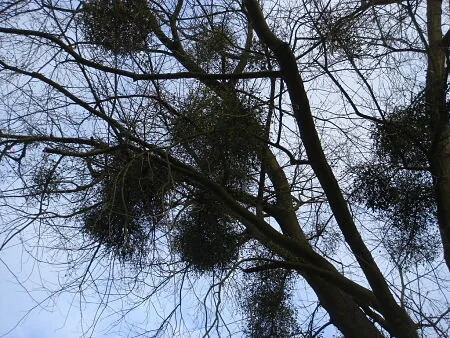
Parasitic clumps of mistletoe in an infested tree.. — NYC Tom/CC
Blame the Norse, though, for the most elaborate of the surviving myths. Frigga, the goddess of love, had a son, Balder, god of summer, on whom she doted. After he dreamed of his own death, she frantically sought assurances from every plant and animal in the air and on the earth that they would do him no harm.
Balder’s sole enemy, Loki, found a loophole in Frigga’s protection racket: The parasitic mistletoe is not rooted in the earth and was therefore exempt from the no-harm pledge. Loki made an arrow of mistletoe and tricked Balder’s blind brother, Hoder, god of winter, into using it to kill Balder.
Frigga’s copious tears changed the mistletoe’s berries from red to white, and Balder was magically raised from the dead. So great was Frigga’s joy that she declared mistletoe a “plant of peace” and kissed everyone who walked under it as a sign of her gratitude.
Symbolic feel-good value aside, mistletoe is actually quite sinister, a vampire of a plant that sinks its roots into the heart of a host tree and sucks its vital sap.
The etymology of its Anglo-Saxon name isn’t very encouraging either. Owing to the fact that it is spread by seeds that have been eaten and eliminated by birds, “mistel” (dung) and “tan” (twig) basically means “dung-on-a-twig.” Some species not favored by birds actually hurl their seeds at high velocity as much as 30 or 40 feet.
The sticky berries adhere to tree bark. Then, like some alien monster, the seed sends out a shoot “flattened at the end like the proboscis of a fly” to pierce the bark and seek the darkness of the tree’s innermost core. Heavily infested trees weaken and can die as their nutrients are slurped up by the interloper. It becomes difficult to kill the mistletoe without killing the host tree — which sounds a lot like science fiction, but is real-life botanical drama.
Since harvesting mistletoe can slow its attack on tree victims and stealing kisses is harmless fun, I favor a revival of the old custom. Let’s get it right, though, and not fail to observe the proper etiquette — for every kiss a berry must be removed, and when the berries are gone, the kissing is over. No cheating now, or pestilence, storm, Norse trouble-makers and braces of white bulls will haunt you all the days of the new year.